
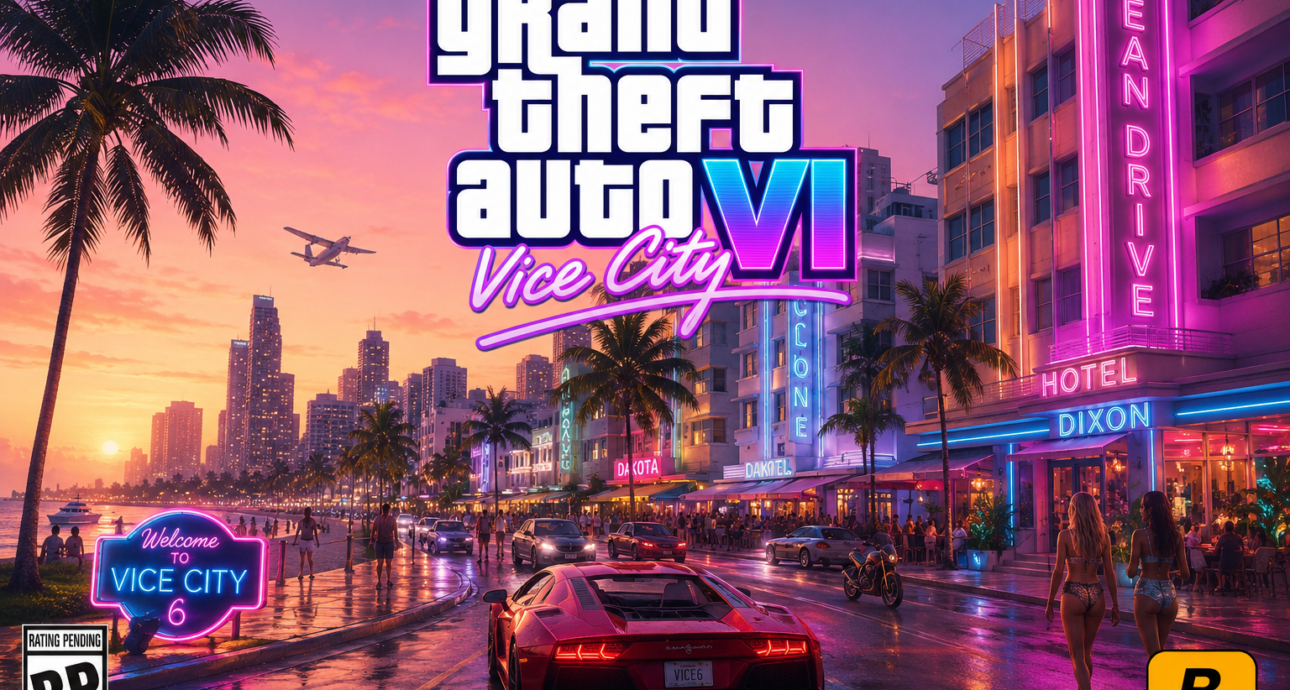
What GTA 6 Teaches Game Developers
GTA 6 is not just a game — it is a masterclass in game development. Whether you run an indie studio or work at a large publisher, Rockstar’s approach contains lessons that apply to every team making games.
Rockstar spent over a decade developing this title with one of the largest production budgets in entertainment history. The result is a game that raised the bar for open-world design, narrative structure, systemic AI, and audio production simultaneously. For every developer watching, it raises a question worth sitting with: what does it look like when a studio refuses to compromise?
This post breaks down 10 concrete lessons from GTA 6’s development — not as abstract inspiration, but as principles you can apply at any scale.

1. Build for Your Hardware — Never Against It
GTA 6 was designed exclusively for PS5 and Xbox Series X/S. Rockstar made a deliberate decision to cut cross-gen compatibility — and it shows in every technical layer of the finished game.
The PS5’s SSD allows Leonida’s open world to stream seamlessly without a visible load screen, even during high-speed transitions between dense urban environments and open wetland terrain. The DualSense haptic feedback system reflects surface texture, weather conditions, and weapon recoil in ways that previous hardware could not physically support. The machine-learning processing power of current-gen CPUs allows NPCs to perform contextual decision-making with a fidelity that would have required pre-scripted responses on older silicon.
Rockstar’s refusal to water things down for legacy hardware is why GTA 6 feels different — not just looks different. The lesson is not “only target the newest platform.” It is: understand your target platform’s actual capabilities at a low level, and then design your systems around those strengths. Too many games treat the platform as a constraint. Rockstar treated it as a canvas.
Key takeaway: Before you begin production, spend a week doing nothing but reading hardware documentation and profiling what your target device can actually do. Then design for its strengths, not against its limits.

2. Character Is Your Greatest Asset
Lucia and Jason are not just playable avatars — they are the emotional engine of the entire game.
Rockstar invested in years of motion capture sessions, facial animation technology, and script revisions to make these two characters feel like real people. Lucia in particular represents a shift in mainstream game storytelling: a female protagonist in the GTA universe with genuine interiority — ambitions, contradictions, and a relationship that evolves based on player choices. Jason’s arc mirrors classic crime fiction but subverts expectations in ways that only interactive storytelling can.

The result is that players talk about Lucia and Jason the way they talk about great television characters — not because the mechanics were innovative, but because the characters felt human. Mechanics create engagement. Characters create attachment. Attachment is what drives word-of-mouth, fan art, streaming content, and community formation long after the credits roll.
Before you finalise your protagonist, ask yourself: does the player have a reason to care about who this person is — not just what they can do? If the answer is no, the character work is not done.
At Phantom Cave, this is the principle we apply to every 3D game character design project — the character has to function narratively before it functions technically.

3. The World Should React — Not Just Exist
GTA 6’s Leonida is a reactive world. NPCs carry persistent memory of player interactions across sessions. The in-game news cycle reports on major events the player triggers. Weather systems affect NPC routines, traffic patterns, and crowd behaviour dynamically. Law enforcement responds based on context rather than just a five-star wanted level script.
The distinction Rockstar made here is one of the most important in game design: scripted events create a single experience. Systemic design creates infinite ones.
A scripted world says “when the player does X, Y happens.” A systemic world says “here are agents, rules, and relationships — emergent outcomes will follow.” The second approach is harder to build but produces experiences that feel genuinely alive. Players in a systemic world tell each other about things that happened to them. Players in a scripted world tell each other about things the game made them see. That difference is everything.
Fan communities have historically driven much of the innovation in how studios think about reactive systems — something we looked at closely in our post on how fan ideas drive innovation in game development.
4. Delay Is Not Failure
GTA 6 was delayed multiple times from its originally anticipated release window. Each delay was met with community frustration — and each delay produced a measurably better game.
The lesson is not “always delay.” It is: the reputation cost of shipping broken is higher than the reputation cost of shipping late. Cyberpunk 2077’s 2020 launch is the case study every studio now references. The bugs, the console refund programmes, the delisted PlayStation Store status — that damage lasted years, and the studio spent three years rebuilding trust. Meanwhile, every GTA 6 delay was forgotten within days of the game launching to near-universal critical and commercial success.
At a studio level, delay decisions require genuine courage. They require leadership willing to have hard conversations with publishers, investors, and community managers. They require a shared belief that the work itself is the priority, not the announcement date.
This tension between creative quality and operational timelines is something every studio lives with. Our post on how our game studio balances creativity and deadlines goes into how we navigate it in practice at Phantom Cave.
5. Polish Is the Product
Rockstar is famous for embedding extraordinary detail into games that most players will never notice: newspapers with full in-world articles, radio stations with original licensed music and scripted DJ banter, NPCs with daily schedules and genuine conversations that continue without the player nearby.
This is not decoration. Polish is the mechanism by which a game world earns belief. The moment a player notices an inconsistency — a character clipping through a wall, an audio loop repeating every 90 seconds, a shop that is always open with no apparent explanation — the illusion breaks. Once it breaks, it is very hard to recover.
Polish is also compounding. Every small detail Rockstar embeds increases the probability that a player will encounter something that surprises them — a unique NPC interaction, an ambient environmental event, a radio segment that seems to directly comment on what just happened in a mission. These encounters generate organic social content: clips, screenshots, Reddit threads, YouTube videos. That content does marketing work the studio does not pay for.
For smaller studios: you cannot polish everything, so identify the 20% of your game that players will spend 80% of their time experiencing and make that exceptional. Focused, minimalist approaches to UI and environment design can help you achieve that kind of polish without a AAA budget — a principle we explored in our post on minimalist UI for immersive storytelling.
6. Dual Protagonists Create More Story Possibilities
GTA V’s three-character structure gave players three perspectives and three distinct gameplay styles. It was technically impressive and commercially successful. GTA 6’s two-character structure made a different creative choice: it built a relationship.
A relationship is narratively richer than a roster of independent viewpoints. When Lucia and Jason disagree, the player feels that tension directly. When one of them risks something for the other, the stakes feel personal. The dynamic between two people — the loyalty, the friction, the way one character’s choices change the other’s options — produces a kind of emotional weight that parallel storylines struggle to match.
This is a lesson in narrative economy. More viewpoints does not mean more story. It often means more exposition, more context-switching, and less emotional depth per character. The best storytelling in games, like the best storytelling in film, tends to do more with less.
Before adding a second or third protagonist to your game, ask what the relationship between them makes possible — not just what their separate stories are.
7. Live Service Requires Trust
GTA Online ran for twelve years because Rockstar kept adding meaningful content: genuinely new game modes, vehicle categories, heist structures, and narrative vignettes — not recycled seasonal cosmetics. Players kept spending because Rockstar kept delivering things worth spending on.
GTA 6 Online launches with that legacy of trust already banked. But for studios starting from zero, the lesson is harder: you cannot buy trust with a roadmap. You earn it by doing what you said you would do, month after month, year after year.
Live service has become the default aspiration for many studios because the recurring revenue model is attractive. But the model only works if the relationship works. Players who feel exploited — loot boxes that provide no gameplay value, content stripped and sold back, servers shut down within two years — do not return and do not recommend you to others.
The studios making live service work long-term are the ones that treat the player relationship as the product, not revenue extraction as the product. Community-first thinking is proving this out even at small scale — as we covered in our post on how smaller studios are beating giants with community support.
8. Market With Restraint
GTA 6 had two trailers before launch. Two. The internet went into meltdown both times. Every frame was frame-by-frame analysed. Background characters became discussion threads. Map coordinates were extracted from reflections. The marketing worked precisely because it was rationed.
Rockstar understood something most marketing teams do not: scarcity of information creates engagement. When you release everything, players have nothing to speculate about. When you release almost nothing, the internet does your marketing for you — for free, at scale, for months.
This is hard to execute when a publishing partner is pressuring you for content drops, developer diaries, and weekly social posts. But the principle holds: know the difference between content that creates anticipation and content that exhausts it. Over-marketing a game erodes the mystery that makes people want to play it. That is a mistake that cannot be undone after the fact.
9. Audio Is Half the Experience
The GTA series has always treated audio as a first-class creative medium: licensed music spanning decades of cultural history, original radio content with fully scripted segments, spatial 3D sound design that makes environments feel volumetrically real, and weapon audio that communicates mechanical information through feel as much as sound.
Audio creates immersion in ways that visuals alone cannot. You can close your eyes in a well-designed game environment and still feel completely inside it. A game with great visuals and generic audio feels hollow in ways the player often cannot explicitly identify — they just feel less present in the world.
Most development budgets allocate audio last and cut it first. This is the wrong order. Audio decisions should be made during pre-production because they affect environment design, pacing, and narrative tone. A composer or sound designer brought in at the start of production makes fundamentally different — and better — choices than one brought in to score a finished game in the final six months.
Treat audio as a design discipline, not a post-production task.
10. Know What Your Game Is About
GTA 6 is about Lucia and Jason. It is about ambition, loyalty, and survival in a system designed to keep people like them from getting what they want. Every mission structure, every open-world system, every tone shift in Leonida serves that central idea.
Rockstar knew this before they built a single asset. And that clarity of creative purpose is visible throughout the finished game — in why certain missions exist, in why the world is shaped the way it is, in why the soundtrack shifts the way it does between sequences.
This is the hardest lesson to apply because it requires answering a difficult question before you have anything to show: what is my game actually about? Not what genre it is. Not what its mechanics are. What idea does it exist to explore? What would be lost if this game did not exist?
Studios that can answer that question make games with identity. Studios that cannot make games that feel generic regardless of technical quality. Before you write a line of code or a line of design documentation, write one paragraph that answers: what is this game about, and why does it matter?

4 Comments
[…] covered more of that in our internal article on GTA 6 game development lessons, where the focus stays on character, polish, reactive systems, and long production […]
[…] This is the same reasoning behind our guide to choosing a game development company in Pakistan: ask for a walkthrough of a specific system, not a list of engines and tools. The answer tells you more about a team’s actual capability than any portfolio reel. This same discipline shows up elsewhere in how we work too, whether that’s balancing creativity against deadlines on a live project or thinking through what makes a game’s narrative actually land. […]
[…] in a game if the writing earns it. GTA 6 proved it at the franchise scale. Our own breakdown of what makes game narratives actually land pulls the specific lessons from that […]
[…] development for Steam. The same engineering discipline behind Project V’s cover system, narrative design approach, and production structure applies to every client project we take […]