
Game development ideas are everywhere. The hard part isn’t finding one. It’s knowing which ideas have legs and which ones die on a whiteboard three months into production.
This guide covers the types of games that studios build and sell in 2026, the features that keep players coming back, and the mechanics that separate a marketable concept from a passion project that ships to nobody. Whether you’re an indie founder scoping your first title or a publisher evaluating what to greenlight next, the breakdown below gives you something more useful than a list of genres — it gives you a frame for making decisions.
This guide is for indie developers, small studio founders, and publishers looking for game development ideas grounded in what’s actually working commercially.
Key Takeaways
- Mobile games dominate revenue but require retention-first design from day one, not as an afterthought.
- Narrative games have surged since 2023, driven by players who want story depth alongside mechanics.
- The most commercially durable game development ideas solve one core player emotion: curiosity, progress, competition, or escape.
- Features like procedural generation, co-op multiplayer, and customization extend player lifetime value more reliably than content updates alone.
- At Phantom Cave Studio, the ideas that have shipped as real titles started with a single, specific player feeling, not a genre category.
Why Most Game Development Ideas Fail Before Launch
Most ideas that fail don’t fail because the concept was bad. They fail because the team never answered the question a publisher or player asks first: what does the player actually do for the first 30 seconds?
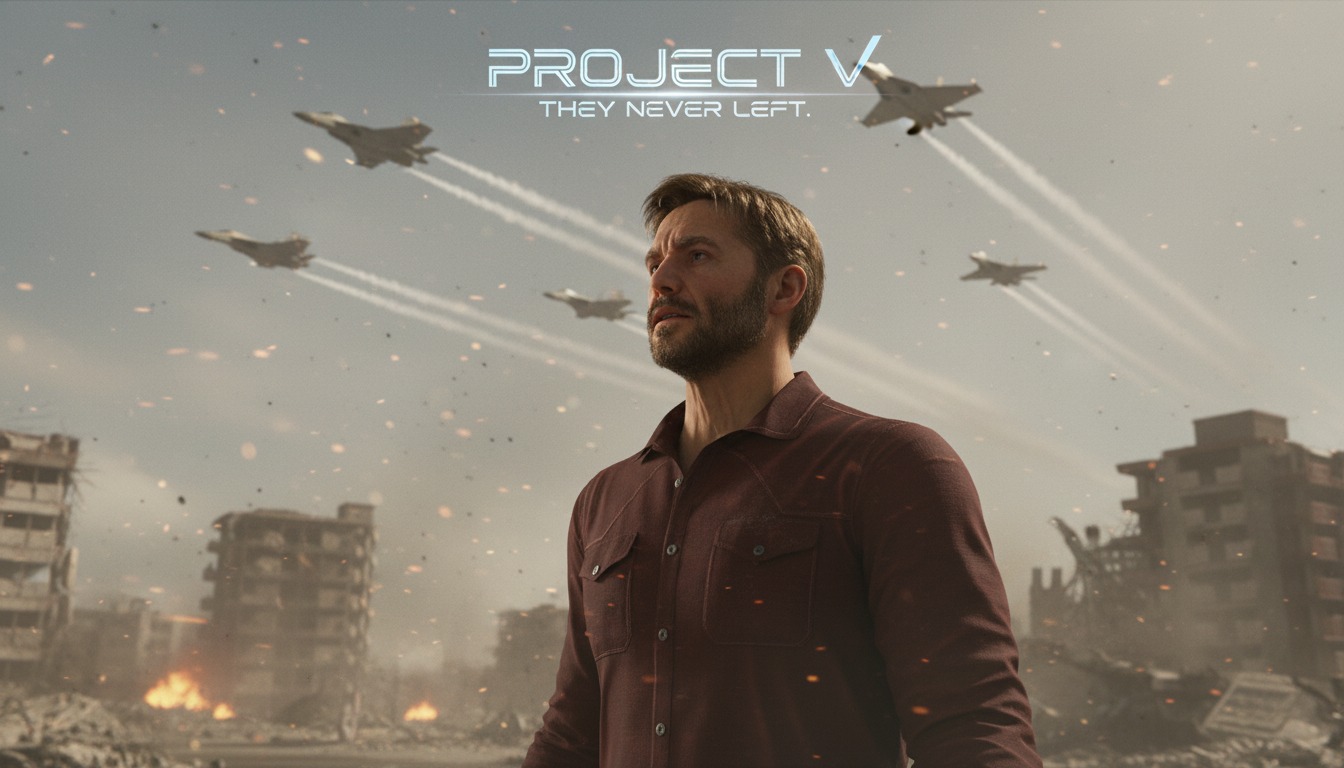
A genre label isn’t an answer. “It’s a survival game with crafting and building” describes half the Steam library. The ideas that survive development pressure are the ones with a specific core loop that’s fun to say out loud in a single sentence. Project V, Phantom Cave Studio’s post-apocalyptic narrative survival title on Steam, started with that test: a player navigating a world where governments lied about the apocalypse, using cover and deception to survive. One sentence. One player feeling. Everything else built outward from there. You can read about how that cover system got built in detail in our Project V technical breakdown.
Types of Games Worth Building in 2026
The global gaming market passed $200 billion in 2024, according to Newzoo’s annual report. Mobile accounts for roughly 49% of that revenue, PC for around 24%, and console for the remaining 27%. Those percentages shape which game development ideas have the largest addressable market, even before you factor in development cost.
Mobile Games
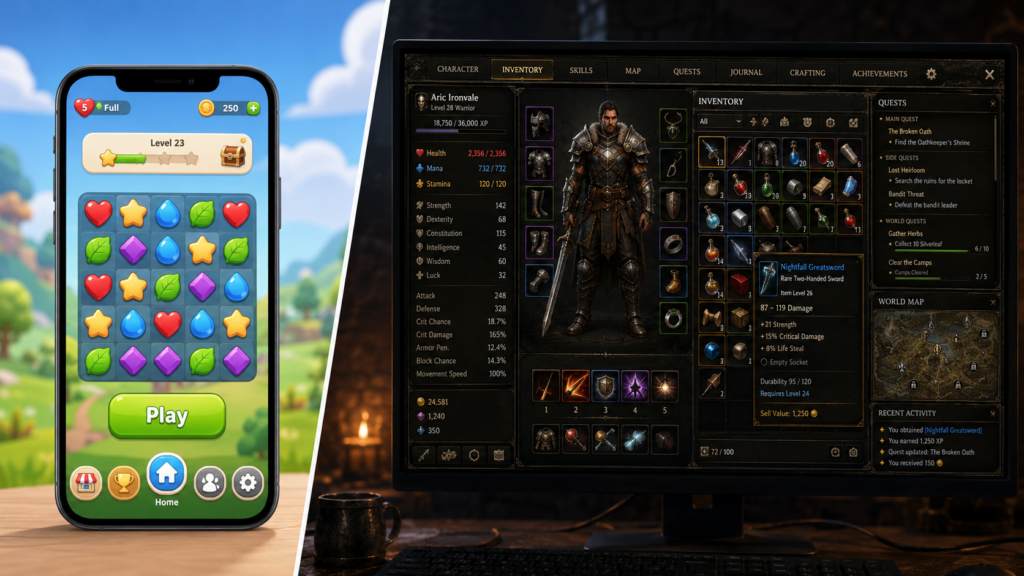
Mobile is the largest single market and the most brutal one. Hyper-casual titles (one-tap mechanics, no tutorial, instant play) dominated from 2018 to 2022, but ad revenue compression has pushed the market toward hybrid-casual and mid-core titles with real progression systems.
The game development ideas that work on mobile in 2026 share three traits. First, the core mechanic is learnable in under 10 seconds. Second, there’s a progression system with visible milestones every session. Third, there’s a social hook, whether competitive (leaderboards, PvP), cooperative (guild systems, gifting), or passive (showing off customization).
At Phantom Cave Studio, our mobile titles including Water Color Sort Puzzle, Race Ventura, and Conquest Tale were each built around a single specific mechanic before any progression layer went on top. That sequencing matters. Studios that build progression first and bolt on a core mechanic later typically ship something that feels like a menu with a game attached. Browse our shipped mobile catalog to see how this plays out in practice.
Narrative and Story-Driven Games
Narrative games are the fastest-growing category on PC and console right now. Titles like Disco Elysium, Hades, and Baldur’s Gate 3 proved that players will pay full price and spend 60 to 100 hours in a game if the writing earns it. GTA 6 proved it at the franchise scale. Our own breakdown of what makes game narratives actually land pulls the specific lessons from that title.
The game development ideas worth pursuing in this space aren’t the ones that want to tell a big story. They’re the ones where story and mechanics are the same thing — where choosing your dialogue option IS the gameplay, or where discovering the narrative IS the progression. Minimalist UI matters here too. As we covered in our piece on minimalist UI for immersive storytelling, the games that land narratively in 2025 and 2026 are the ones that trust players to read the room instead of plastering information across every corner of the screen.
Multiplayer and Social Games
Co-op and competitive multiplayer titles have the highest potential ceiling and the highest development risk. The ceiling is high because multiplayer games retain players through other players, not through content updates from the dev team. The risk is high because a multiplayer game with no players is worse than a singleplayer game with no players — it’s visibly, obviously dead.
Game development ideas in this category need a minimum viable player base strategy built into the design. Small-room co-op (2 to 4 players) is more forgiving than open-world MMO design because the game works as long as one friend group plays it together. The community-driven approach that smaller studios use to compete with larger publishers is worth reading before committing to any multiplayer concept.
Simulation and Idle Games
Simulation and idle games are the most underrated category for small studios. They require less real-time performance optimization than action games; they retain players across longer sessions without live content, and they benefit from the kind of gradual depth that fans document on wikis and forums for years.
The game development ideas that work here reward curiosity. The player doesn’t need to be challenged every second. They need to feel like they’re discovering something new every few sessions, which is why procedural generation and unlock trees matter so much in this category.
Game Features That Extend Player Lifetime Value
Genre choice gets you to market. Feature design determines how long players stay. These are the features with the strongest correlation to long-term retention across categories.
Procedural Generation
Procedural generation extends replay value without requiring the team to create new hand-authored content for every session. Roguelikes like Hades and Dead Cells built entire communities on procedural level design. Even games that aren’t primarily roguelikes can use procedural elements in loot systems, enemy spawning, and world events to make each session feel distinct.
The key constraint: procedural generation needs guardrails. Pure randomness isn’t fun. Players need to feel like the system is varied, not arbitrary.
Progression Systems With Visible Milestones
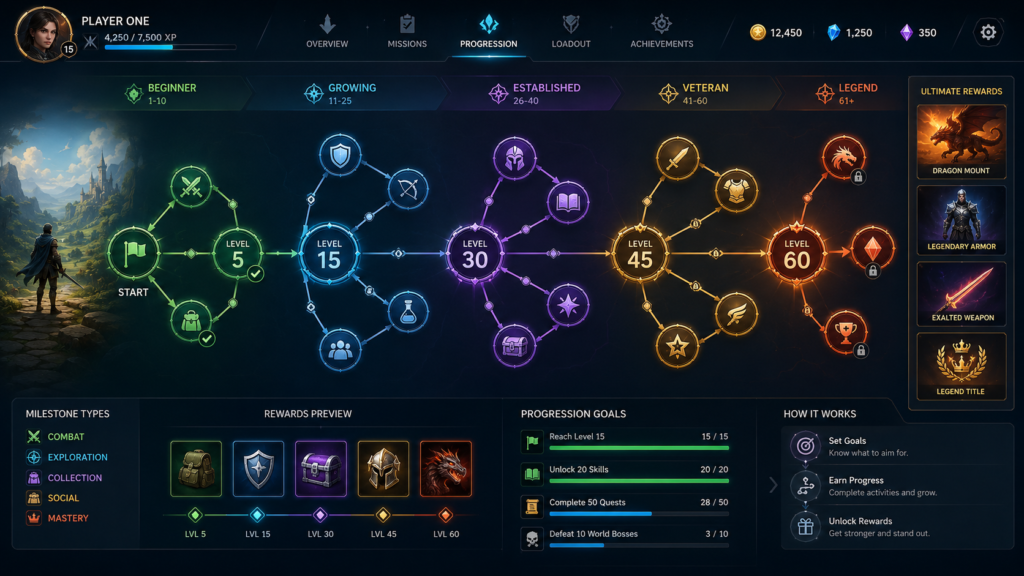
Progression is the feature players think they don’t need until they stop playing a game without one. The research from game longevity studies on loot and modding culture shows that games with visible, near-term milestones retain players 3 to 4 times longer than games where progress feels gradual and invisible.
The milestone design rule: the player should always be able to answer “what am I working toward right now” in under five seconds, without opening a menu.
Customization and Player Expression
Customization drives both retention and word-of-mouth. Players who have invested time personalizing a character, base, or loadout are less likely to quit and more likely to show other players what they’ve built. Cosmetic customization also creates a monetization path that doesn’t require pay-to-win mechanics.
Community and Social Features
Games that let players create together, compete publicly, or share discoveries have a built-in content engine the dev team doesn’t have to maintain. Leaderboards, replay sharing, modding support, and guild systems all extend the player community past the content the studio shipped. Fan-driven content is increasingly where game development ideas come from at the sequel stage, not just from internal brainstorming. Our piece on how fan ideas drive innovation covers this dynamic in detail.
How to Validate a Game Development Idea Before You Build
Validation before production saves more time than any workflow optimization during production. These four tests apply regardless of genre or platform.
The one-sentence test. Describe the core loop in a single sentence to someone who doesn’t play games. If they understand what the player does and why it would be satisfying, the idea has a foundation. If they look confused, the concept needs simplifying before it needs an engine.
The platform fit test. Put the idea next to the top 10 games in its genre on the target platform. Does it clearly belong? Does it offer something different enough to earn a download over an established title? Genre without differentiation is a position, not a pitch.
The retention hook test. Ask what brings the player back for session two. If the answer is “they want to see what happens next,” you have narrative drive. If the answer is “they’re halfway through the progression tree,” you have progression hooks. If the answer is “they want to beat their friend’s score,” you have social hooks. A game with none of the three has a problem that no amount of production quality fixes.
The budget reality test. The average indie title on Steam costs between $50,000 and $500,000 to ship. Mid-core mobile games run $250,000 to $2 million. Before a concept goes into pre-production, it needs a scope that matches the available budget. We cover the full cost breakdown in our companion article on how much it costs to develop a game.
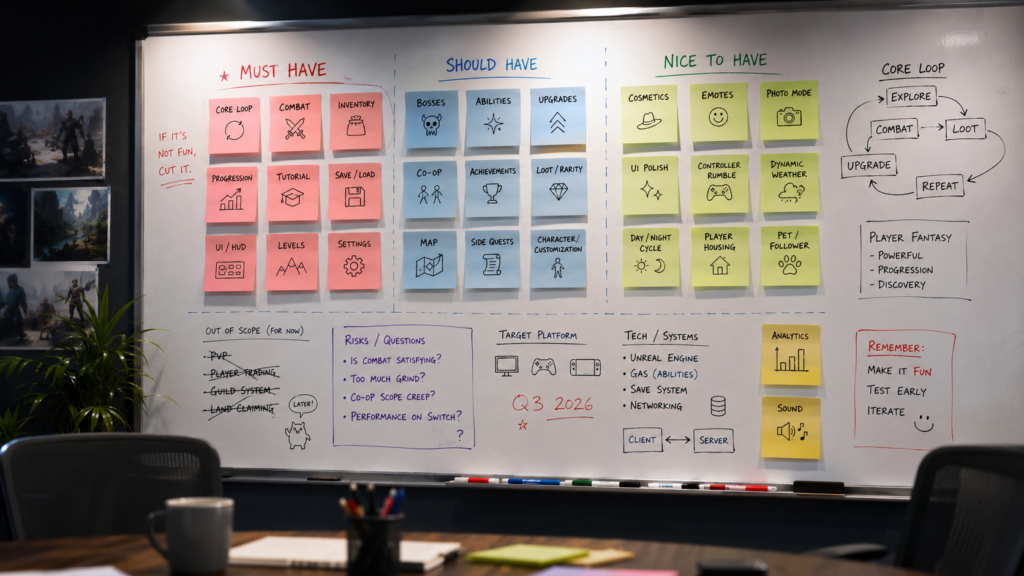
Phantom Cave Studio’s Approach to Developing Game Concepts
At Phantom Cave Studio, incubated at the National Incubation Center in Karachi, game development ideas go through the same filter regardless of platform. The first question isn’t “what engine should we use?” or “what’s trending on the App Store this month?” It’s “what specific moment do we want the player to feel, and what’s the simplest mechanic that creates that moment?”
That approach produced Water Color Sort Puzzle (the satisfaction of restoring order), Race Ventura (the adrenaline of near-miss competitive speed), and Project V (the dread of realizing the world you thought was recovering isn’t). Each one started with a feeling, not a genre. The genre came after. See how that plays out across our full catalog.
If you’re at the concept stage and want a studio that can help scope, validate, and build — from the core loop through to store submission — get in touch with us here.
Frequently Asked Questions
Small studios do best with focused, single-mechanic concepts. Hyper-casual mobile, narrative puzzle games, and small-room co-op titles are the strongest fits because they don’t require large content libraries or live operations teams to feel complete at launch.
Originality in games is mostly about combination, not invention. Most successful games recombine familiar mechanics in a specific context that feels fresh. Ask whether your combination exists already, not whether each individual element is new.
Visible progression milestones, social hooks (competitive or cooperative), and a clear answer to “what am I working toward right now” matter most. Customization and procedural variety extend retention after the core content is exhausted.
Mobile has a larger addressable market but requires a retention-first design approach and significant user acquisition budget at launch. PC has lower download volume but higher per-player revenue and a more forgiving community for early access titles. Your budget and team size usually make the decision — not the market size alone.
How does Phantom Cave Studio approach new game concepts?
Every concept starts with a single target player emotion and the simplest mechanic that creates it. Platform, engine, and production scope come after that core question is answered. That order matters more than any specific methodology or toolchain.
Ready to Turn Your Game Idea Into a Real Title?
A good concept deserves a team that knows how to build it. At Phantom Cave Studio, we work with founders and publishers from concept validation through full-cycle development and store launch. Tell us about your project and we’ll tell you what it takes to ship it.
3 Comments
[…] who want to understand whether a mobile-first or full-cycle approach fits their concept, our game development ideas guide walks through that decision in […]
[…] The clearer your brief, the better the proposals you receive. Weak briefs produce padded proposals designed to hedge scope risk. A tight brief produces specific answers you can compare meaningfully. For help thinking through game types and core mechanics before you brief a studio, see our game development ideas guide. […]
[…] If you’re trying to decide between Unity and Unreal before you brief a studio, see our game development ideas guide for the platform-first decision framework that should come before the engine […]