Choosing between the best game development engines in 2026 isn’t a technical question. It’s a project question. The engine that built Fortnite is a bad choice for a hyper-casual mobile puzzle game. The engine powering 70% of top-grossing mobile titles is a poor fit for a photorealistic open-world RPG. And the fastest-growing engine in the market right now is still the wrong call for anything that needs console certification.
This guide gives you the real numbers, the genuine trade-offs, and a clear decision framework — so you choose the engine your project needs, not the one with the loudest community on Reddit.
This guide is for indie developers, studio founders, publishers, and clients evaluating game development services who need to understand which engine fits which project before committing to a build.
Key Takeaways
- Unity still dominates mobile at roughly 48% market share and powers about 70% of the top-grossing mobile games in 2026.
- Unreal Engine holds 31% of units sold on Steam by revenue, compared to Unity’s 26% — meaning Unreal disproportionately powers higher-budget, higher-revenue titles.
- Godot has grown from 25,000 starred GitHub projects in 2020 to over 100,000 in 2026</cite>, making it the fastest-growing engine in the market by developer adoption.
- Unity is dominant in volume. Unreal is dominated by revenue. Godot is the fastest-growing option but is still primarily used for smaller-scope projects.
- C++ game development sits inside Unreal Engine’s core. Unity runs on C#. Godot uses GDScript (Python-like) with native C# and C++ support as well.
- NFT game development companies and blockchain-integrated games predominantly use Unity and Unreal, with Unity having deeper Web3 SDK ecosystem support.
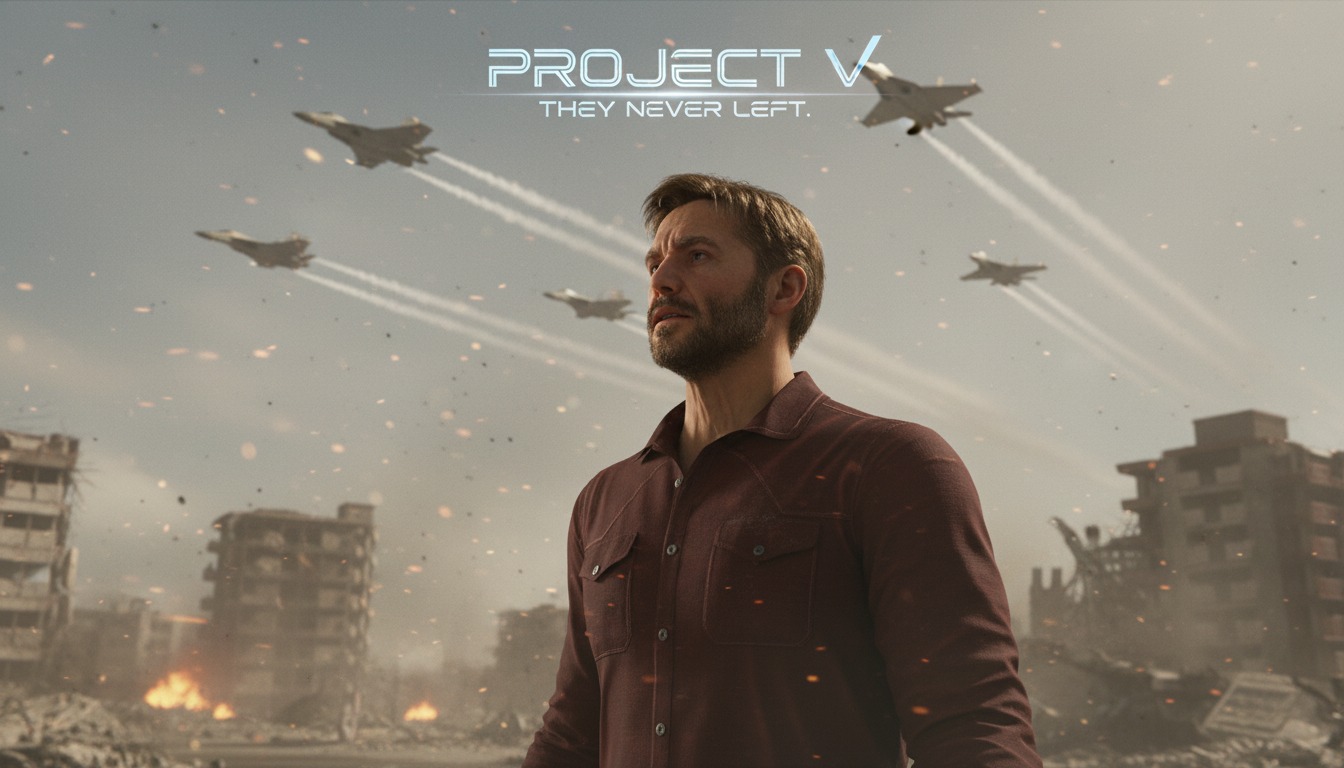
- At Phantom Cave Studio, we build in Unity for mobile and are developing Project V for PC. The engine choice is made per project, not per preference.
The 2026 Engine Landscape: What Actually Changed
To understand the current engine market, you have to understand the recent history that reshaped developer sentiment. Unity’s 2023 runtime fee controversy and the subsequent “Great Migration” sent a massive influx of talent into open-source alternatives like Godot. Meanwhile, Epic Games solidified its dominance in the AAA space, positioning Unreal Engine 5 as the centre of gravity for high-fidelity production.
The result is a market where developers are more engine-literate than ever. Studios now maintain hybrid pipelines and evaluate engine choice per project rather than defaulting to one tool for everything. Unity’s runtime fee was cancelled in September 2024. Unity Personal remains free up to $200K in revenue or funding. Unity Pro starts at the $200K threshold, with a 5% price increase that took effect January 12, 2026.
Godot 4.6 landed in January 2026 with Android device mirroring, improved Google Play Billing, Google Play Games Services, and Apple StoreKit 2 integrations. Godot remains MIT-licensed and charges zero royalties forever.
Unreal Engine 5.7 doubled down on tooling for small teams, making it meaningfully more accessible to studios that previously found its complexity prohibitive.
Engine 1: Unity 6 — The Mobile and Cross-Platform Standard
Unity is the default engine for cross-platform game development. It’s been the dominant tool for mobile game development since the late 2000s and hasn’t been displaced in that category despite years of alternatives attempting it.
The Numbers
- Unity powers approximately 70% of the top-grossing mobile games in 2026.
- It deploys to more platforms than any other engine from a single codebase: iOS, Android, Windows, macOS, Linux, WebGL, PS4/PS5, Xbox, Switch, and VR/AR.
- Unity makes up approximately 50% of all mobile games and over 70% of the top 1,000 mobile titles.
Technical Strengths
Unity 6 is the most significant release in years. The rendering pipeline has matured with adaptive probe volumes and the GPU Resident Drawer, delivering meaningfully better visual quality with less manual setup.
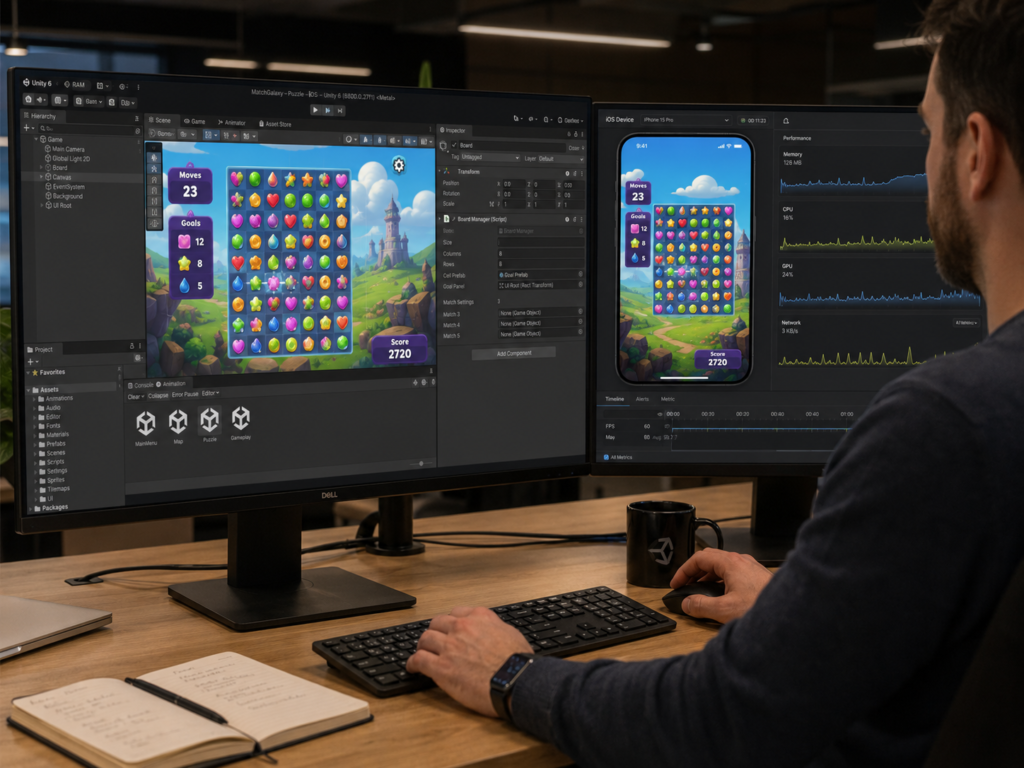
For mobile development specifically, Unity’s profiling tools — Frame Debugger, Memory Profiler, Profile Analyzer — its device coverage, and its optimisation toolchain are more mature than what Godot or Unreal offer for mobile targets.
The Asset Store and third-party ecosystem remain Unity’s largest competitive advantage for small and mid-sized teams. Networking solutions like FishNet, Mirror, and Photon, UI frameworks, shader packs, and complete game templates can save weeks of development time.
Unity is also the engine of choice for iOS game development. Its iOS build pipeline handles App Store submission requirements, Metal rendering, and Apple Silicon optimization with less friction than any alternative. If your project includes iOS game development as a primary target, Unity is the answer before you’ve asked the second question.
Weaknesses
Unity’s 3D graphics capabilities still fall short of Unreal’s. The engine suffers performance issues not experienced by its main competitors, including crashes caused by Unity’s less-integrated core features and heavy reliance on third-party tools. C# is the sole language Unity supports via its scripting API, which limits development options and slows performance compared to Unreal’s native C++ support.
Unity Pricing in 2026
- Personal: Free up to $200K annual revenue or funding
- Plus: $399/year per seat
- Pro: $2,040/year per seat (required above $200K threshold)
- No royalties on any tier
Choose Unity if:
You’re building for mobile (iOS, Android, or both), need cross-platform deployment from a single codebase, want the largest third-party asset and plugin ecosystem, or are hiring developers since Unity has the deepest hiring pool of any engine. <cite index=”10-1″>For most studios in 2026, Unity is the right choice. It supports more platforms than any other engine, has the deepest mobile profiling tools, the largest asset ecosystem, and the strongest hiring pool.</cite>
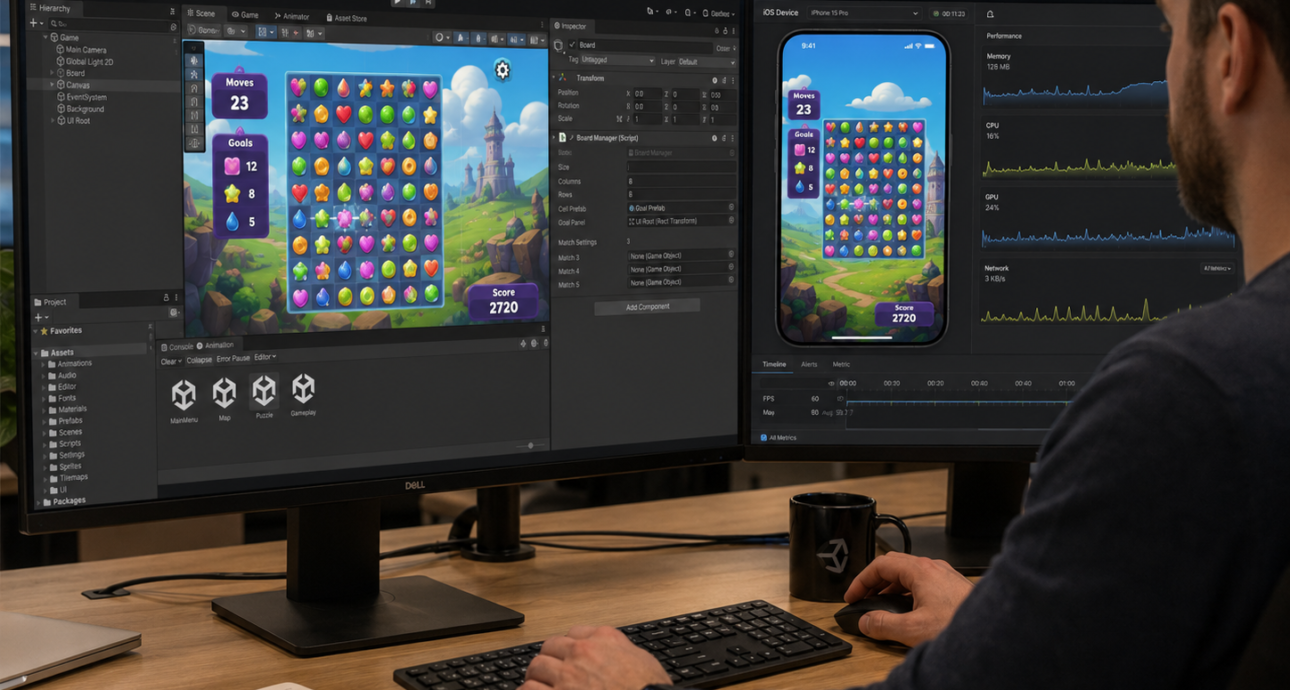
At Phantom Cave Studio, Unity is the engine behind our shipped mobile catalog — Water Color Sort Puzzle, Race Ventura, and Conquest Tale. It’s also the engine powering the Project V cover system, which we built using Unity’s animation system alongside FinalIK and Cinemachine. The technical breakdown of that system shows what Unity can handle at the engineering level when it’s used properly.
Engine 2: Unreal Engine 5.7 — The AAA and High-Fidelity Standard
Unreal Engine is the ceiling of real-time visual quality in 2026. If your game’s competitive identity is tied to how it looks — photorealistic environments, cinematic character models, dynamic lighting that rivals pre-rendered film — Unreal is the only engine that delivers it at production scale.
The Numbers
- Unreal Engine powers 31% of Steam units by revenue, compared to Unity’s 26% — meaning it disproportionately powers higher-budget, higher-revenue titles.
- Unreal is dominant by revenue. AAA and AA titles disproportionately use it.
- Unreal Engine 5 is free until $1 million in revenue, then charges a 5% royalty above that threshold.
Technical Strengths
Lumen (real-time global illumination) and Nanite (virtualized geometry) have eliminated traditional light-baking and LOD management in Unreal 5, saving artists thousands of hours.
Unreal 5.7 has moved past its experimental phase to become a mature production powerhouse. For any studio targeting photorealism on PC, PS5 Pro, or next-gen consoles, Unreal is the default choice.
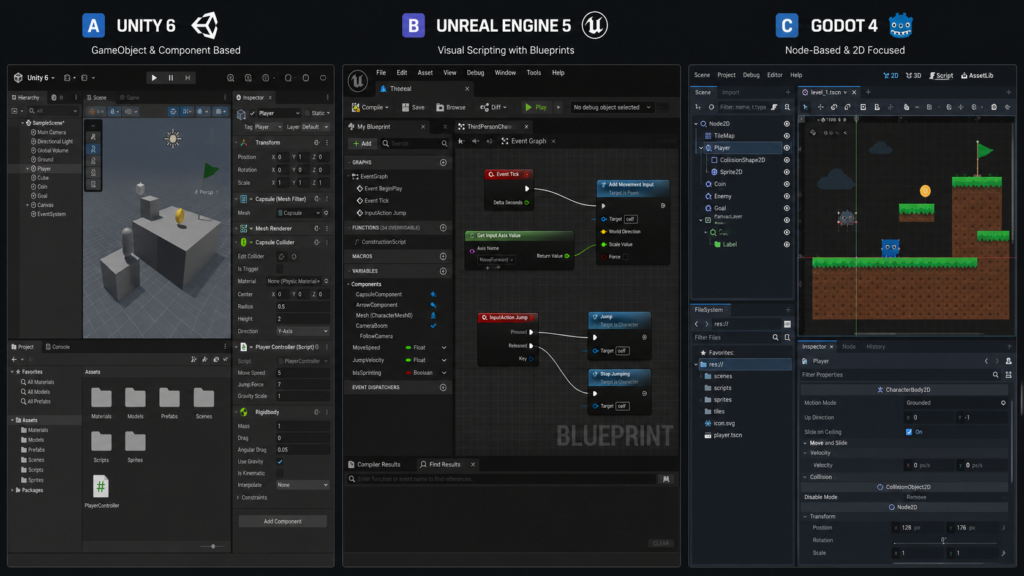
Unreal’s Blueprint visual scripting system allows non-programmers to build complex game logic without writing C++. For studios with strong artists and designers but limited engineering headcount, this is a genuine productivity advantage. C++ game development sits at Unreal’s core — senior engineers who want direct system-level control have full access to the engine’s source code, something Unity’s architecture doesn’t offer at the same depth.
Beyond gaming, Unreal is increasingly popular in architecture, film production, and virtual simulations</cite>, which expands the pool of developers with production Unreal experience beyond pure game studios.
Weaknesses
Unreal Engine is resource-intensive, requiring high-specification hardware to run it. Using Unreal for a 2D game, a lightweight 3D title, or a mobile game is generally over-engineering. Unreal Engine 5 projects grow very large very fast, requiring consistent naming conventions and structured asset organisation to remain manageable.
Unreal’s design as a professional-grade engine gives it a steeper learning curve than Unity or Godot. Hiring experienced Unreal developers costs more than hiring Unity developers, and the pool is smaller outside AAA studio markets.
Unreal Engine 5 Pricing in 2026
- Free until $1 million lifetime revenue per product
- 5% royalty on gross revenue above $1 million
- Full source code access included for all licensees
Choose Unreal if:
Your game’s visual identity requires photorealism, you’re targeting PC or next-gen console as the primary platform, you have the team size to manage a complex codebase, or C++ game development is a core requirement. For 3D game development at AAA or AA fidelity, Unreal is the only realistic choice.
Our 3D game development services are built around both Unity and Unreal pipelines, depending on project scope. For clients targeting Steam with high visual fidelity as a differentiator, Unreal is the honest recommendation. For clients targeting mobile-first with 3D elements, Unity is.
Engine 3: Godot 4.6 — The Open-Source Challenger
Godot is the fastest-growing engine in the market by almost every metric that matters for developer adoption: GitHub stars, community size, and new release volume on Steam. Godot 4.6 has crossed from a hobbyist tool to a credible production engine for indie developers who want zero royalties and zero seat fees.
The Numbers
- Godot has grown from 25,000 starred projects on GitHub in 2020 to over 100,000 in 2026.
- Godot has gone from a rounding error in early 2024 to a clearly visible slice of new Steam releases — meaningful growth, mostly concentrated in 2D and smaller-scope 3D projects.
- The Godot editor is approximately 50MB — compared to Unity and Unreal installs measured in gigabytes.
Technical Strengths
- -Godot’s 2D pipeline is arguably the best of the three engines. It has dedicated 2D physics, a true 2D coordinate system (not a 3D engine with a 2D wrapper), and lightweight rendering, making it excellent for platformers, top-down games, visual novels, and strategy games.
-Godot 4.6 features a highly efficient Vulkan-based renderer and an elegant node-based scene system that makes complex hierarchies easier to manage than in Unity or Unreal.
-GDScript, Godot’s primary scripting language, is Python-like in syntax and genuinely fast to write. It also supports C# and C++ natively. Godot is MIT-licensed, meaning game creators can use, alter, and distribute it without owing any royalties, subscriptions, or fees — ever.
Weaknesses
-Godot struggles to handle high-end 3D projects with complex physics. The engine has fewer features than Unity for commercial game development and dropped visual scripting support as of version 4.
-Godot doesn’t include consoles among its cross-platform support due to integration requirements conflicting with its open-source policy. Its community is smaller and less established than Unity’s or Unreal’s, resulting in fewer tutorials and a smaller asset store.
-Hiring developers with Godot experience is harder than hiring Unity or Unreal developers, which matters for commercial projects that need to scale a team. Multiplayer support is less mature than Unity or Unreal.
Godot Pricing in 2026
- Completely free forever under the MIT licence
- Zero royalties on any revenue level
- Full source code access with no restrictions
Choose Godot if:
You’re building a 2D game, a stylised low-poly 3D title, or a rapid prototype. You want zero licensing risk and full source code ownership. You’re a solo developer or a very small team that doesn’t need console certification. Godot provides an incredible, risk-free, and lightweight environment for developers prioritising speed and open-source freedom.
Engine Comparison Table: 2026
| Criteria | Unity 6 | Unreal Engine 5.7 | Godot 4.6 |
|---|---|---|---|
| Primary Strength | Mobile, cross-platform, 2D | AAA 3D, photorealism, console | 2D, open-source, indie |
| Scripting Language | C# | C++, Blueprints | GDScript, C#, C++ |
| Mobile Support | Best in class | Limited, high-end only | Good, improving |
| iOS Game Development | Best in class | Possible, not optimal | Possible, not optimal |
| 3D Game Development | Strong | Best in class | Capable, not AAA |
| C++ Game Development | Limited (C# only) | Full native C++ | Supported natively |
| NFT/Web3 Support | Strong SDK ecosystem | Growing | Minimal |
| Console Support | Yes (Pro licence) | Yes | No |
| Pricing | Free to $200K, then $2,040/yr | Free to $1M, then 5% royalty | Free forever, MIT |
| Learning Curve | Moderate | Steep | Easy to moderate |
| Hiring Pool | Largest | Large (AAA focus) | Growing, still smaller |
| Best For | Mobile, indie, cross-platform | PC, console, AAA/AA | 2D indie, open-source |
Game Development Software Beyond the Big Three
The three engines above handle the vast majority of commercial game development services. But specific use cases have better-fit tools.
GameMaker remains the strongest dedicated 2D engine for developers who don’t want Godot’s node architecture. Undertale and Hotline Miami were built in it. Its GML scripting language is immediately accessible, and the tool runs on modest hardware.
CryEngine offers comparable visual fidelity to Unreal for open-world environments, with a royalty-free licence structure (5% royalty only if you choose revenue sharing). It has a smaller developer community and fewer third-party plugins than either Unreal or Unity.
O3DE (Open 3D Engine) is the open-source successor to Amazon Lumberyard, backed by the Linux Foundation. <cite index=”6-1″>It’s particularly relevant for enterprise-grade simulations and cloud-integrated games requiring AWS-native infrastructure.</cite> Not a mainstream choice for indie or mobile game development, but worth knowing for large-scale multiplayer or simulation projects.
Godot for NFT game development? The honest answer is no — not yet. NFT game development companies and blockchain-integrated games predominantly use Unity and Unreal because both engines have mature Web3 SDK ecosystems (Thirdweb, Moralis, ChainSafe) that Godot’s ecosystem doesn’t yet match. If blockchain integration is a core requirement, Unity is the more pragmatic choice in 2026.
How to Choose: The Decision Framework
\Each engine solves a different problem. The best one depends on your experience level, the scale of your project, and how quickly you want to iterate.</cite> Run through these five questions in order.
1. What’s your primary platform? Mobile-first → Unity. PC/console high-fidelity → Unreal. 2D indie or web → Godot.
2. What’s your team’s existing skill set? C# background → Unity. C++ background or Blueprint-comfortable artists → Unreal. Python-comfortable or open-source-oriented → Godot.
3. What’s your budget for engine licensing over three years? Zero budget → Godot or Unreal (under $1M revenue). Predictable subscription preferred → Unity. Revenue-share comfortable → Unreal.
4. Do you need console certification? Yes → Unity (Pro) or Unreal. No → any of the three.
5. What does success look like in 18 months? A shipped mobile game with real retention data → Unity. A PC title that competes on visual quality → Unreal. A completed indie game with no licensing overhead → Godot.
For context on what these engine decisions mean for a real game development services budget, see our breakdown of how much it costs to develop a game — engine choice affects labour cost, hiring cost, and production timeline meaningfully.

Phantom Cave Studio: What We Build and With What
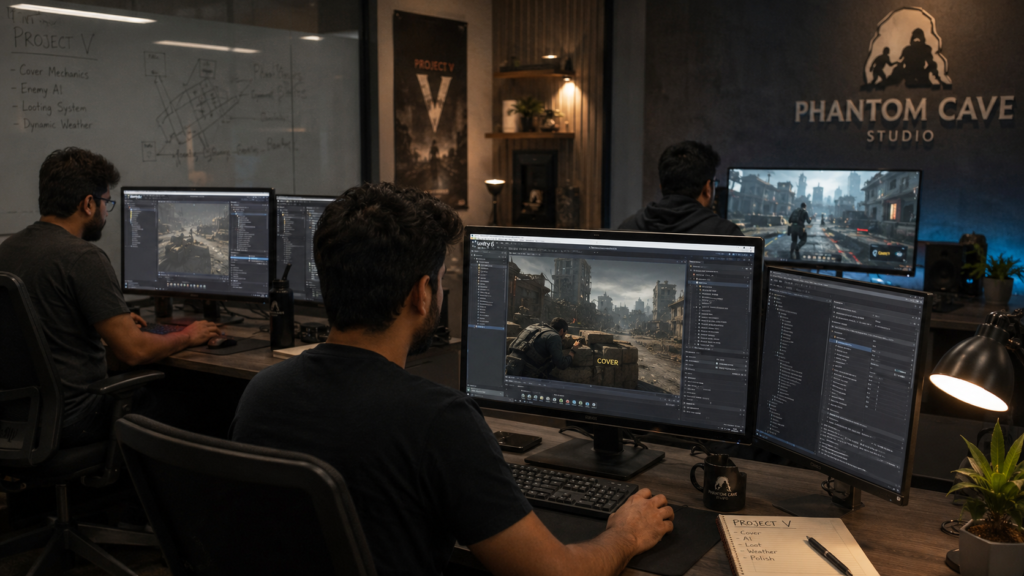
At Phantom Cave Studio, we’re a Unity game development company for mobile and cross-platform work, and we evaluate Unreal for PC titles where visual fidelity is the competitive differentiator.
Our shipped mobile catalog — Water Color Sort Puzzle, Race Ventura, Conquest Tale — is built in Unity. Project V on Steam is built in Unity, with FinalIK and Cinemachine extending the core engine for the cover system mechanics documented in our technical deep-dive.
We offer game development services across mobile, PC, and 3D game development for international clients in the UK, USA, Canada, and beyond. Engine selection is part of the scoping conversation — we recommend based on the project requirements, not on which engine we happen to prefer. If you’re trying to decide between Unity and Unreal before you brief a studio, see our game development ideas guide for the platform-first decision framework that should come before the engine question.
For clients specifically evaluating a game development studio who want to understand how engine choice affects budget, timeline, and hiring, our affordable game development guide covers that in detail.
Ready to Choose Your Engine and Start Building?
Engine choice is the foundation of every game development decision that follows it. Choose the wrong one, and you’re fighting the tool for the duration of the project. Choose the right one, and it becomes invisible — a platform your team ships on, not a problem they manage around.
At Phantom Cave Studio, we make this decision with every client before a line of code is written. Tell us about your project — platform, scope, timeline, budget — and we’ll tell you which engine fits it and why. If you want to understand what the options look like before that conversation, browse our work and read how we build for international clients at affordable rates.
Frequently Asked Questions
Unity is the default pick for teams shipping cross-platform mobile games at scale.It powers approximately 70% of top-grossing mobile games and has the most mature iOS build pipeline, App Store submission tooling, and mobile performance profiling of any engine.
Unreal Engine is the primary answer. C++ is Unreal’s native language and underpins the entire engine’s performance architecture. Godot also supports C++ natively. Unity does not support C++ for scripting — it uses C# exclusively via its scripting API.
Godot 4.6 has crossed from a hobbyist tool to a credible production engine for indie developers. However, it remains primarily used for smaller-scope projects and 2D development. For commercial 3D titles targeting PC at significant visual fidelity, Unity or Unreal remains a stronger choice in 2026.
Most NFT game development companies use Unity or Unreal Engine. Unity has the most mature Web3 SDK ecosystem, with support for Thirdweb, Moralis, and ChainSafe integrations. Unreal has growing blockchain support but a smaller Web3 plugin ecosystem than Unity. Godot’s Web3 ecosystem is still early-stage.
We build mobile and cross-platform titles in Unity. Project V is built in Unity with FinalIK and Cinemachine extensions. We evaluate Unreal for client projects where photorealistic 3D is the visual differentiator. Engine selection is part of every project scoping conversation.
Significantly. Unity’s larger developer hiring pool typically means lower labour costs on mid-size teams. Unreal requires more senior engineers and longer onboarding, which increases cost. Godot has a smaller hiring pool, which can increase cost despite the zero-licence-fee advantage. Engine choice also affects production timeline — a team switching engines mid-project is one of the most expensive things that can happen to a game development budget. See our full game development cost guide for a detailed breakdown.